Guatemala's Plastic Crisis Is Now Visible From Space. Why River Interceptors Alone Can't Solve It
Around two percent of all plastic entering the world’s oceans each year is estimated to come from Guatemala’s Motagua River alone, turning one country’s waste emergency into a measurable share of global ocean pollution.
Satellite and aerial imagery now make that leakage visible as dense plumes of debris at river mouths and along coastal currents. If we can track the crisis from orbit and quantify its contribution to ocean plastic, the practical question for ESG teams, journalists, and policymakers is straightforward: why is the problem still growing—and what kind of recovery model could actually reverse it?
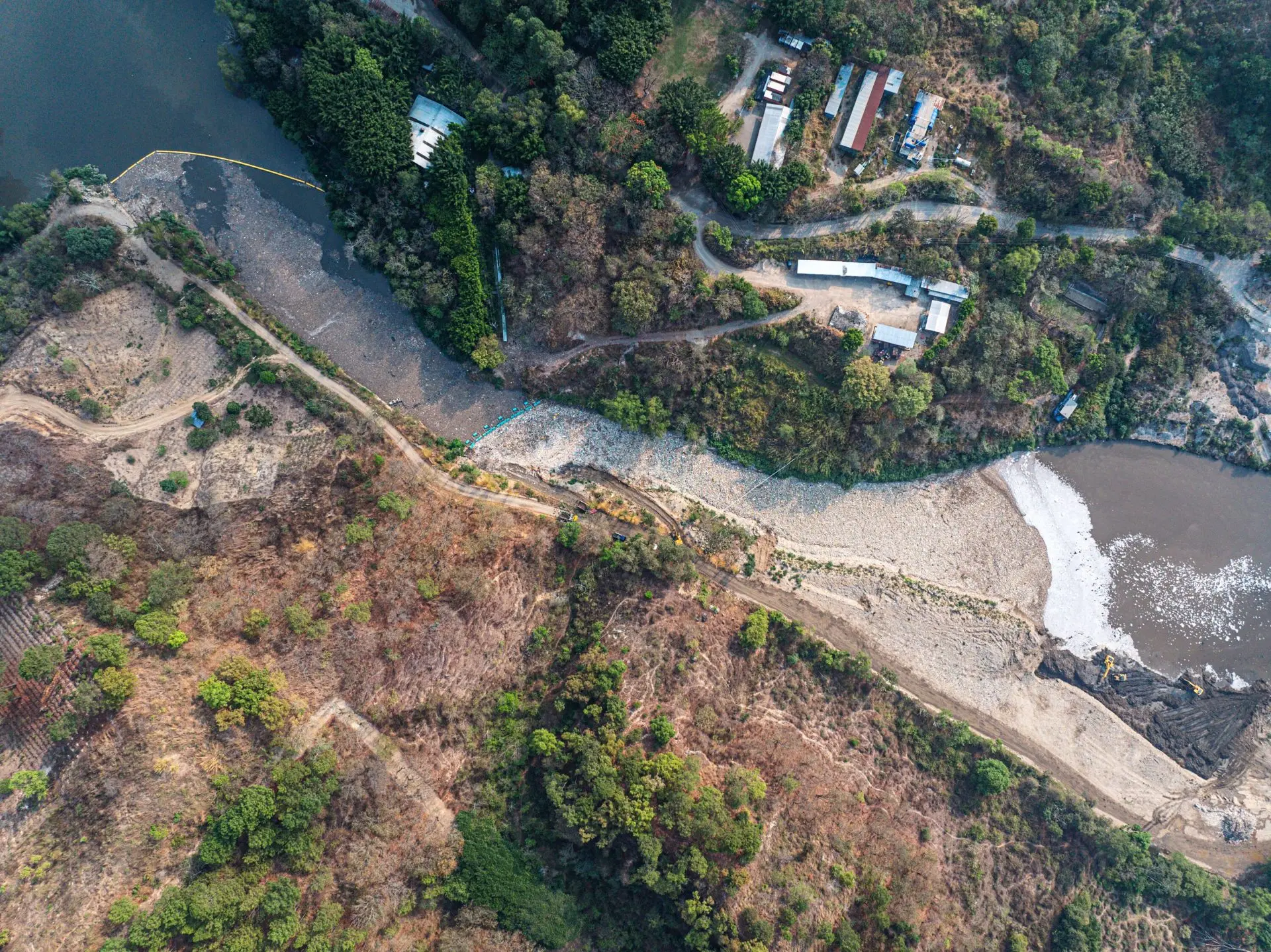
Plastic plumes from Guatemala’s Motagua and Las Vacas basin can now be detected from the air and by satellite, turning a local waste emergency into a visible global leakage point.
When a River Becomes a Global Problem
The Motagua River is widely cited as one of the most plastic‑polluting rivers on the planet, with estimates indicating that it contributes roughly two percent of global plastic emissions into the oceans. That figure is not driven by a single spill or industrial accident; it is the result of a long chain of structural failures in solid‑waste management and wastewater treatment across the basin.
For decades, the main landfill serving Guatemala City and surrounding municipalities has operated on a hillside that drains into the Las Vacas River, a key tributary of the Motagua. During heavy rains, mixed municipal waste, industrial residues, and medical refuse are washed out of the site and into the river system. At the same time, national assessments indicate that formal collection systems still fail to reach a large share of the population, meaning a significant fraction of household and commercial waste is dumped informally in ravines, streambeds, and vacant lots that connect directly to creeks and rivers during the rainy season.
As that unmanaged waste moves downstream, it does not simply disappear. A growing body of research on river‑borne plastic shows that large accumulations of macroplastics can be detected as distinctive signatures in satellite and aerial imagery at river mouths and along coastal currents. In the case of Guatemala, those signatures are now visible where the Motagua enters the Gulf of Honduras and along stretches of Caribbean coastline in neighboring countries, making the basin one of the clearest examples of how inland waste systems translate into ocean pollution.
From the Motagua to the Pacific: The Same Crisis on Both Coasts
Guatemala’s plastic crisis is often framed through the lens of the Motagua and the Caribbean, but the country’s Pacific basin tells a similar story. Rivers such as María Linda in Escuintla have been identified as some of the most plastic‑polluting waterways in Central America, carrying on the order of a million kilograms of plastic per year toward the Pacific. Other rivers, including the Samalá and Naranjo, add their own loads of mixed waste to the coastal current.
The effect becomes painfully visible when storms hit. During Tropical Storm Cristina in June 2026, widely shared footage showed the beach at Ocós blanketed with bottles, packaging, and assorted debris swept out of river mouths during intense rainfall. Local authorities and environmental organizations traced the material back to upstream communities and river systems rather than to offshore dumping, underscoring how quickly inland waste can be mobilized to the coast when drainage channels are full of unmanaged trash.
Investigations along the old road to Puerto San José and other coastal routes have also documented open dumpsites perched above ravines and intermittent streams. These sites function as unofficial transfer stations: waste accumulates until the first major storm, then gravity and runoff move it into waterways connected to the Pacific. When taken together with the Motagua’s contribution to the Caribbean, these patterns show that Guatemala’s plastic leakage is systemic and national in scale, not isolated to one river or one coast.
What Interceptors Capture — and What They Miss
River‑based interception efforts have proven that it is possible to stop significant volumes of plastic once it is already moving. The Ocean Cleanup’s Interceptor Barricade installed on the Las Vacas River, for example, had removed on the order of 857 metric tons of trash from the waterway within its first operating seasons, measured in hundreds of truckloads that did not reach the Motagua’s mouth. Local initiatives using “biobardas” and other low‑tech barriers have added to this, with community‑run projects recovering hundreds of tons of floating waste in a single year for sorting, recycling, or conversion into construction materials.
These interventions are complemented by new financing for upstream infrastructure. The Inter‑American Development Bank’s US$250 million program for the Motagua basin is designed to expand formal waste collection, build treatment plants in critical sub‑basins such as Las Vacas, and create integrated waste‑management centers along the river corridor. Combined, these measures are intended to reduce the volume of solid waste and untreated effluent entering the river network, and to support the long‑term closure or transformation of open dumpsites.
Yet interception has hard limits. Barriers can only capture what has already escaped into the channel, and they depend on constant maintenance, seasonal adjustments, and stable funding. As long as landfills perched above rivers continue to operate without full containment, as long as informal dumps remain scattered along ravines, and as long as large shares of municipal waste never enter formal collection, rivers will keep delivering new waves of plastic to those interception points. In that sense, interceptors are essential—but they are treating symptoms, not the underlying metabolism of materials that feeds the problem.
The Difference Between Interception and Recovery
Interception and industrial recovery are often mentioned in the same breath, but they represent fundamentally different approaches. Interception is reactive and downstream: it waits for waste to reach the river and then tries to stop it before it reaches the sea. Industrial recovery is proactive and upstream: it aims to capture plastic while it is still on land and convert it into economically valuable feedstock that will not be discarded in the first place.
In practice, interception projects are measured in tons removed, kilometers of river covered, and number of trash “tsunamis” mitigated. Their operating budgets rely on grants, public–private partnerships, and international cooperation. Industrial recovery facilities, by contrast, are measured in tons processed into pellets, flakes, and finished products, and their viability depends on long‑term contracts with buyers who need recycled materials at specific quality levels. The more plastic they receive and transform, the healthier their business becomes.
From an ESG and procurement perspective, interception produces clear environmental benefits but does not automatically create a traceable material stream that reenters manufacturing. It cleans up, but it does not necessarily “close the loop.” Industrial recovery can do both: it diverts plastic away from landfills, waterways, and coasts, and then feeds that material back into supply chains as recycled resin or durable products. That dual role is what allows companies to link purchase orders to metrics such as recycled content, ocean‑bound diversion, and CO₂ savings, rather than to general support for cleanup activities.
One Facility Built on That Principle
On Guatemala’s Pacific side, OCEANPET has been designed around the idea that plastic recovery has to be industrial, continuous, and economically grounded if it is going to be permanent. Located in Masagua, Escuintla, roughly 45 minutes from Puerto Quetzal, the facility operates under a free‑trade regime and focuses exclusively on non‑food‑grade recycled materials for industrial use. Its model is not to collect river litter directly, but to remove the economic logic that lets plastic reach rivers in the first place.
The plant produces recycled PET resin pellets with intrinsic viscosity in the 0.72–0.78 dL/g range, around 99.5% purity, moisture below 0.2%, and a uniform 3–4 mm spherical geometry suitable for polyester fiber, strapping, thermoforming, and sheet applications where food contact is not required. It also produces high‑purity PET flakes and structural plastic wood lumber manufactured from recycled plastics, all from post‑consumer and ocean‑bound streams rather than virgin resin. That combination of outputs allows OCEANPET to integrate into multiple industrial supply chains, from textiles to packaging and construction.
On the sourcing side, OCEANPET concentrates on catchment areas that send plastic toward the Pacific: rivers such as María Linda and Paso Hondo, coastal collection points near Puerto San José and Iztapa, and urban recovery networks in Escuintla. By building stable demand for material from these zones and documenting the volumes processed, the facility turns part of Guatemala’s Pacific‑bound plastic into long‑life industrial inputs, including lumber products with expected lifespans of more than 20 years in outdoor environments.
To meet ESG and procurement expectations, OCEANPET operates under an Ocean‑Bound Plastic certification administered by Control Union, providing chain‑of‑custody documentation that ties each batch of material to its region of origin. For buyers, that means shipments are accompanied by certificates of analysis, recycled‑content documentation, and CO₂ savings estimates per ton. In other words, the facility is structured not only as a recycler, but as a traceable supplier of ocean‑bound rPET and plastic lumber within the Americas.
What ESG Teams and Procurement Should Look for in Suppliers
For ESG teams and procurement managers, the main takeaway is that not all “plastic solutions” are equal from a supply‑chain perspective. Cleanup projects deliver visible environmental wins and can be important philanthropic or CSR partners, but they rarely provide the kind of batch‑level traceability and product consistency needed to support packaging claims, recycled‑content targets, or formal sustainability reporting. Industrial recovery facilities that operate as suppliers, by contrast, can embed those requirements into their normal way of doing business.
When evaluating recycled PET and ocean‑bound plastic suppliers, buyers increasingly look for three things: clear documentation of origin and chain of custody; verified CO₂ reductions compared to virgin materials; and alignment with regulatory trends such as EU minimum recycled‑content mandates and extended producer‑responsibility schemes. Nearshoring is part of this equation as well. Suppliers in Central America can offer shorter lead times and more resilient logistics than distant markets, provided they meet the same technical and documentation standards.
Guatemala’s plastic crisis has become visible from space because decades of underinvestment in waste infrastructure, wastewater treatment, and land‑use control converged with steep topography and heavy rains. Reversing that picture will certainly require more river barriers, more treatment plants, and more enforcement—but it also requires making plastic recovery economically permanent. For companies that want their ESG and procurement decisions to reflect that shift, working with verified ocean‑bound rPET and plastic‑wood suppliers in Guatemala is one way to move from watching the crisis from orbit to reshaping its material flows on the ground.